What the deep plane is and why it matters
The face is made of layers that age at different rates, and each facelift technique works on one of them. Understanding which layer the problem is in is what makes it possible to choose the technique.
The layers of the face
From the surface inwards:
- Skin. It loses elasticity, collagen and thickness. Texture, fine lines and pigmentation depend on it, and sagging hardly at all.
- Subcutaneous tissue. It holds the superficial fat compartments, which empty and descend unevenly.
- SMAS (superficial musculoaponeurotic system). A continuous fibromuscular sheet that connects the muscles of facial expression to the skin and supports the middle and lower thirds of the face.
- Retaining ligaments. Fibrous bands that anchor the tissues to bone or to the deep fascia. They stay fixed while the tissue around them descends.
- Deep plane. The space beneath the SMAS, above the facial muscles and the parotid-masseteric fascia.
Beneath everything lies the bone, which also resorbs over the years and changes the support of the face. That plane is treated by other procedures, such as facial bioosteoplasty.
Why folds form
The nasolabial fold and the marionette line appear because the tissue above a ligament descends while the ligament holds it in place. Pulling the skin does not undo that anchor. Releasing the ligament, which is what the deep plane approach does, does act on it.
What the SMAS is
The SMAS is the layer that gives structural support to the cheek and the jawline, and the one that is repositioned in almost every modern facelift. What changes between techniques is how it is handled: folded, trimmed, lifted or, in the deep plane, released together with the skin as a single unit. It is explained in detail in what is the SMAS.
Deep plane, SMAS or skin only: what each technique corrects
Each row of this table answers a different anatomical problem. The examination tells which one is yours.
| Surgical plane | What it corrects well | Limitations |
|---|---|---|
| Skin traction only | Very mild excess skin. Short post-operative period. | It does not act on the deep support. All the tension falls on the skin and the scar, the effect tends to be short-lived and it can look pulled. |
| SMAS (plication, SMASectomy or SMAS flap) | Repositions the support of the lower third and defines the jawline. A reproducible technique with a long track record. | The retaining ligaments are not released, so the midface and the nasolabial fold improve less. Skin and SMAS are moved separately. |
| Deep plane | Midface and nasolabial fold. Repositioning as a single unit along a vertical vector, with less tension on the skin. | Wider dissection, closer to branches of the facial nerve. Technically more demanding. It offers no advantage in every ageing pattern. |
Working in the deep plane has four practical consequences:
-
The skin does not bear the tension. The anchoring is done on the SMAS and the deep tissues, and the skin redistributes. That is why the face tends to look less tight.
-
Vertical vector. Facial ageing is mostly a descent, and taking the tissue back upwards comes closer to reversing it than pulling it towards the ear, which is what widens the face.
-
Midface. Once the ligaments are released, the cheek fat can be repositioned, and that softens the nasolabial fold in a way that skin traction does not achieve.
-
A scar under less tension. A scar that does not bear traction tends to mature better and to widen less.
Types of facelift considered in consultation
Deep plane is a way of performing the facelift, and it is applied with a different extent depending on what each face needs. These are the options assessed in Dr. Verbauvede's consultation, with the anaesthesia and the indicative times explained there.
-
Technique: Mini jowl lift
- What it acts on
- Jawline and early laxity. The angle between face and neck.
- Anaesthesia
- Sedation or local anaesthesia
- Indicative recovery
- 7-12 days, with mild swelling for a few days
- Can be combined with
- Temporal lift
-
Technique: Deep plane facelift
- What it acts on
- Moderate or advanced laxity, sagging cheeks and midface, nasolabial folds
- Anaesthesia
- Sedation or general anaesthesia
- Indicative recovery
- Gradual. Stitches are removed between days 10 and 14
- Can be combined with
- Platysma correction or temporal lift
-
Technique: Deep plane neck and facelift
- What it acts on
- Midface, lower face and neck. Double chin, neck bands and jawline contour.
- Anaesthesia
- General anaesthesia or deep sedation
- Indicative recovery
- Between 12 and 14 days
- Can be combined with
- Often, a temporal lift
-
Technique: Temporal lift
- What it acts on
- Lateral brow descent, tired look and lines at the outer corner of the eye
- Anaesthesia
- Sedation or local anaesthesia
- Indicative recovery
- Slight swelling. Stitches out between days 12 and 14
- Can be combined with
- Blepharoplasty or mini jowl lift
-
Technique: Platysma correction
- What it acts on
- Platysmal bands and fat under the chin
- Anaesthesia
- Sedation or local anaesthesia
- Indicative recovery
- Between 7 and 10 days
- Can be combined with
- Mini jowl lift or deep plane facelift
Indicative times. The indication and the technique are set after the in-person assessment, according to each patient's anatomy, medical history and expectations.
Cervicofacial facelift: face and neck in one operation
The cervicofacial facelift, or cervicofacial rhytidectomy, works on the face and the neck in the same operation: the SMAS in the face and the platysma, its continuation, in the neck. It is usually done under general anaesthesia or deep sedation and lasts several hours. Most patients return to social life between two and four weeks later, and the residual swelling keeps going down for months.
It does one specific thing well, which is to return tissues that have descended to their place. Whatever depends on other planes is outside its reach:
Corrects well
- Sagging of the lower third of the face
- Laxity of the jawline
- Nasolabial folds caused by tissue descent
- Loss of the angle between chin and neck
- Vertical platysmal bands
- Excess skin on the neck and under the jaw
Does not correct
- Skin quality and texture
- Pigmentation, redness and sun damage
- Fine lines around the mouth
- Eyelid laxity (that is blepharoplasty)
- Loss of bone or fat volume
- A double chin made only of fat, without laxity
Mini facelift
The mini facelift is a limited surgical approach, with shorter incisions and less dissection, and its indication is narrow: early laxity, skin with good tone, a neck that keeps its angle and little fat under the chin. The details are in mini facelift: who it is and isn't for.
The neck: deep neck and platysma
A neck can look poorly defined because of excess skin, fat or volume sitting beneath the platysma, and no traction from the outside reaches that last one. Deep neck surgery is the work in that deep compartment: fat below the platysma, the submandibular glands and the anterior bellies of the digastric muscles.
If only the face is treated in a neck like that, the jawline improves and the neck angle stays obtuse. That is why, when the neck is the main problem or comes together with facial sagging, the deep plane facelift and the deep neck are planned as a single, combined procedure.
The chin counts too. A chin with little projection shortens the neck angle and limits what tightening the tissues can achieve. In some patients chin surgery or a profileplasty plan does more than widening the neck dissection.
Platysmal bands, the double chin and when operating on the neck alone is enough are explained in neck lift.
What a deep plane facelift does not do
A deep plane facelift:
-
Does not improve skin quality or remove fine lines, pores or pigmentation. That is addressed with sun protection and surface treatments.
-
Does not restore volume. Over the years deep fat and bone are resorbed, and repositioning tissues does not fill a face that has lost volume.
-
Does not change bone volume, nor does it replace working on the chin or the jaw when the problem is one of projection.
-
Does not treat the eyelids. Upper eyelid skin and lower eyelid bags are treated with blepharoplasty, sometimes in the same operation.
-
Does not stop ageing. The process carries on from the new starting point.
If what worries you is mainly the skin, first compare what each non-surgical option can and cannot do. If it is loss of bone support, the option to consider is facial bioosteoplasty.
Who is a candidate, and when not to have surgery
The indication comes from the examination: thickness and quality of the skin, position of the cheek fat, depth of the folds, condition of the platysma, fat beneath the muscle, chin projection and what the patient expects. A face with good cheek support and sagging limited to the neck gains little from a deep plane facelift and takes on a larger dissection.
Age does not decide the indication
There is no right age for a facelift. Some faces have a clear indication in their late forties and others do not have one at sixty. What matters is the degree of sagging, the quality of the skin and what really bothers the patient.
Reasons not to have surgery
Sometimes the right answer is not to operate, or not yet. These situations advise against it:
- The reason is not your own face, or someone else is pushing the decision.
- The expectation does not match what surgery does: looking like a photograph, nothing showing at all, or going back to how you were at thirty.
- A body image disorder is suspected.
- Your health advises against it: poorly controlled blood pressure, anticoagulation that cannot be safely stopped, a decompensated illness or an active infection.
- You smoke and cannot stop before and after surgery.
- Your weight is not stable.
- The problem lies elsewhere: skin quality, the upper third of the face or bone support.
- You cannot take on the recovery at this point.
Risks and how they are reduced
The deep plane is a more demanding technique that depends more on the surgeon, because the dissection runs close to branches of the facial nerve. Temporary weakness of a branch is possible and usually resolves within weeks. Permanent injury is uncommon, and even so it must be explained before surgery.
Then there are the risks of any facelift:
- Haematoma. It is the most frequent complication, usually appears in the first hours and may need to be drained.
- Changes in sensation in the cheeks, neck and earlobe, almost always temporary, although they can take months to return to normal.
- Scars, which are hidden along the contour of the ear and in the scalp and can widen in some patients.
- Hair loss around the incisions, asymmetry and the need for minor touch-ups.
- The risks of anaesthesia, higher in smokers and in people with poorly controlled high blood pressure.
Part of that risk depends on the patient and can be reduced: stopping smoking for weeks before and after, keeping blood pressure under control, especially in the first days, and attending every follow-up visit. The pre-operative assessment also serves to rule out surgery when it is not worth it.
What to ask at the consultation
More than the name of the technique, it is worth asking:
- Which plane will be dissected.
- Which retaining ligaments will be released.
- Along which vector the tissue will be repositioned.
- Whether the neck will be approached above or below the platysma.
- Which of the things that bother you can be corrected with surgery and which depend on the skin or on volume.
- What risks you take on and how much recovery time you really need.
- What happens if you do not have surgery.
A clear, specific answer to each one is a good sign. The last one is a legitimate option and should be on the table.
The process
-
Assessment consultation
Study of the face and neck, medical history and expectations. It leads to the indication and the surgical plan, or to the advice not to operate. The first assessment can be online to guide the case; the in-person visit is essential before surgery.
-
Surgical plan and anaesthesia
The type of anaesthesia depends on the extent of the surgery and on each patient: local, local with conscious sedation, or general. General anaesthesia involves one night in hospital.
-
Surgery
It is performed in a hospital. In some cases drains are placed, which are removed the next day, and a chin strap is prescribed for the first week.
-
Recovery and follow-up
Post-operative medication is prescribed. The first stitches are removed around day seven and the scalp stitches around day twelve. Times vary with each patient.
Recovery: indicative timeline
Swelling peaks between the third and the fifth day, stitches are removed during the second week and most patients with non-physical work go back to it around the third or fourth week. The result settles over the first year.
-
When: 24-48 hours
- What to expect
- Dressing, drains if used, pressure and tightness, monitoring for haematoma
- Activity
- Rest, sleep propped up
-
When: Days 3-7
- What to expect
- Peak swelling and bruising, dressing removed, first wound care
- Activity
- At home, soft diet
-
When: Week 2
- What to expect
- Stitches removed, numb areas, tightness
- Activity
- Gentle walks
-
When: Weeks 3-4
- What to expect
- Swelling hardly visible, pink scars, make-up possible
- Activity
- Back to non-physical work
-
When: Months 2-3
- What to expect
- Residual swelling, firm areas softening, sensation returning
- Activity
- Gradual exercise
-
When: Months 6-12
- What to expect
- Scars mature, result settled
- Activity
- Full normal life
Indicative ranges. They vary with the technique, whether the neck was treated, and each patient.
Some signs cannot wait until the next follow-up visit: pain that increases on one side only, a rapid increase in swelling in the face or neck, fever or discharge from the incisions, difficulty moving part of the face, and changes in skin colour.
Each phase, including what is normal even if it is alarming, is covered in facelift recovery week by week. If you are travelling to Madrid from elsewhere in Spain or from abroad, first see how your stay is organised.
Madrid Deep Plane: the doctor trains other surgeons in the technique
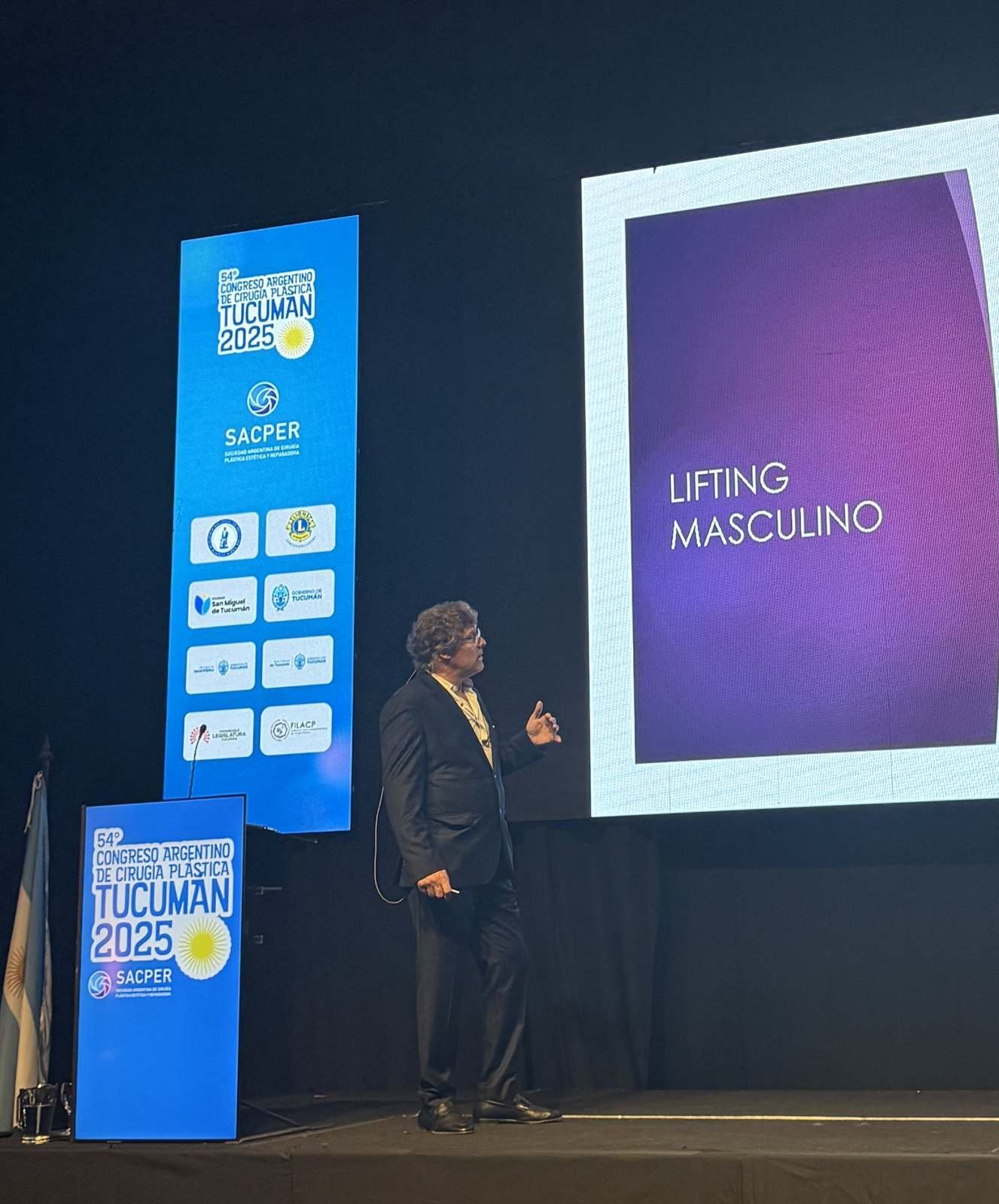
Founder and medical director of Madrid Deep Plane Facelift Masterclass, Dr. Mauricio Verbauvede leads this course for plastic and facial surgeons who want to bring the deep plane into their practice.
It combines live surgery at Hospital Memorial Publio Cordón with anatomical dissection in a cadaver lab. The syllabus covers deep plane dissection, release of the retaining ligaments, the facial nerve danger zones and the deep neck step by step.
Video
-
Facelift patient progress: before, 3 weeks and 1 month
Frequently asked questions
What is the difference between a deep plane facelift and a SMAS facelift?
A SMAS facelift works on the support layer without releasing the retaining ligaments, and skin and SMAS are moved separately. A deep plane facelift dissects beneath the SMAS, releases those ligaments and moves skin, fat and SMAS as a single unit. That is why it acts better on the midface and the nasolabial fold. The dissection is wider and runs closer to the facial nerve.
Does it leave a visible scar?
All surgery leaves a scar. In a facelift the incisions are placed in front of the tragus of the ear, behind the ear and in the scalp. For the first months they are pink and then they fade. How they evolve depends on the tension they bear, on smoking and on sun protection during the first year.
How long is the recovery?
Most patients with non-physical work go back between the third and the fourth week. It is wise to keep two full weeks free of commitments and not to plan important events in the first month. The result is judged from the sixth month and is considered settled at one year.
Can the neck be operated on alone?
Yes, when the sagging is concentrated in the neck and the cheek keeps good support. In other faces, treating only the neck leaves an unbalanced contrast with a midface that has descended. It is decided at the examination.
At what age is a deep plane facelift done?
There is no right age. The criterion is anatomical: degree of sagging, skin quality and what bothers the patient. There are indications in the late forties and faces that have none at sixty.
Is it done under general anaesthesia?
It depends on the extent. A deep plane facelift is done under sedation or general anaesthesia, and a deep plane neck and facelift under general anaesthesia or deep sedation. General anaesthesia involves one night in hospital. It is decided after the assessment of each case.
How do I know if I am really being offered a deep plane facelift?
Ask which plane is dissected, which retaining ligaments are released, along which vector the tissue is repositioned and whether the neck is approached above or below the platysma. A clear, specific answer to all four is a good sign.
Can I have the consultation in English if I am coming from abroad?
Yes. Dr. Verbauvede and his practice see patients in English and in Spanish. If you live abroad, the first assessment can be online, and the in-person visit before surgery is essential.
How much does a deep plane facelift cost?
The quote depends on the type of operation and the approach each case needs, so it is given after the medical assessment.